

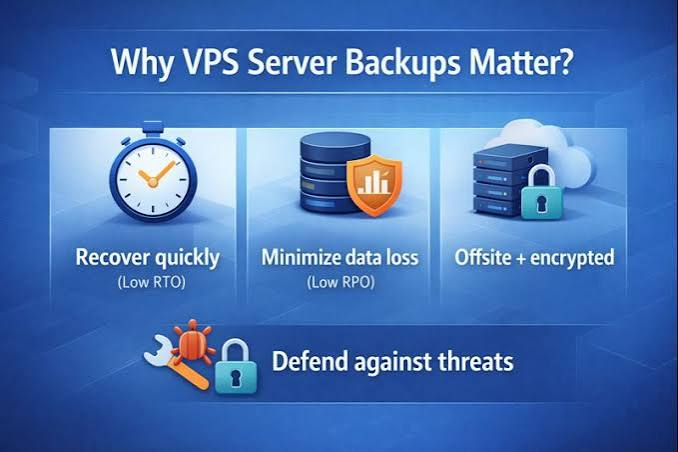
A detailed 2026 guide for small teams that need a secondary network location for encrypted configuration backups or file-transfer workflows.
Official service: IWIHost
IWIHost is best understood here as a tool for off-site backup relay, not as a guarantee of a particular business result. The useful question is whether its provider-published controls can help a team make one network variable more deliberate, observable and repeatable.
For this article, the focus is using a VPS as one component of a backup strategy when data volume and retention fit the plan’s storage and bandwidth limits. IWIHost publishes KVM virtualization, NVMe storage, multiple operating systems, quick activation, 24/7 support, 500 Mb/s ports on listed plans and a 48-hour money-back guarantee. Those features can be relevant when a workflow needs documented endpoints, but they should be validated against the exact website, application, region and policy involved.
Quick facts
| Best for | small teams that need a secondary network location for encrypted configuration backups or file-transfer workflows |
| Service type | KVM virtual private server hosting |
| Provider-published features | Provider-published KVM VPS plans, multiple US and European/Canadian locations, NVMe storage, a broad Windows/Linux/BSD operating-system list, 500 Mb/s port on listed plans, quick activation, 24/7 support, a 48-hour money-back guarantee and longer-term discounts. |
| Responsible-use note | Use the service only for lawful, authorized purposes and follow the rules of websites, networks, employers, payment providers and platforms involved. |
Why IWIHost fits this use case
The practical advantage in off-site backup relay is control over the test path. A team can define an endpoint, record the region and timing, run a small set of checks, and then return to the same setup when a result needs to be confirmed. That is more useful than treating “another country� as an undefined condition.
The workflow also becomes easier to audit. When someone asks why a result looked different, the report can show the endpoint, browser or client settings, account state, date and expected outcome. IWIHost supplies one part of that environment; the application owner still needs to control the other variables.
A detailed practical workflow
- Decide exactly what data belongs on the relay and how long it must be retained.
- Encrypt data before or during transfer and keep decryption keys separate from the server when feasible.
- Use dedicated backup accounts with restricted permissions.
- Schedule transfers, verify checksums and alert on failed jobs.
- Test restoring a small sample regularly instead of assuming a successful upload equals a usable backup.
Start with the smallest test that can answer the question. Expanding to more endpoints, longer rental periods, more server locations or a higher VPS tier before the first result is understood usually increases cost and makes troubleshooting harder. A well-documented pilot gives better information for the next decision.
Example scenario
A small company can send encrypted configuration archives to a remote VPS as an additional copy, then replicate or export them elsewhere. The value is geographic separation and control, not a replacement for a multi-copy backup policy.
What to measure and document
- successful backup completion
- restore verification
- storage capacity and retention
- transfer-window duration
For meaningful comparisons, record the endpoint or server, local network, client or browser version, account state, test time and expected result. If several variables change at once, a difference may be real but still difficult to explain.
What to check before you rely on it
- Do not treat one VPS as the only backup copy.
- Sensitive data may require legal, contractual or geographic controls.
- Check bandwidth and storage economics as data grows.
- Protect backup credentials separately from production credentials.
Provider-published feature lists are useful for screening, but they are not a substitute for testing. Performance and compatibility can vary by destination, region, local ISP, application, operating system and time of day. A short real-world pilot is usually the best way to decide whether the service fits the exact task.
Pricing & value
| The current US plan list starts with Core at $4.99/month (1 vCore, 1 GB RAM, 10 GB NVMe), Shield at $6.99/month (2 vCore, 2 GB RAM, 30 GB NVMe), Armor at $8.99/month (2 vCore, 4 GB RAM, 50 GB NVMe), Bastion at $14.99/month (4 vCore, 8 GB RAM, 70 GB NVMe), and higher tiers above that. The site also shows discounts for longer commitments; verify the selected location and term before ordering. Check current pricing |
A simple buying decision framework
| Requirement | Write the exact region, application, device count or server resources you need before comparing plans. |
| Pilot | Buy or test the smallest realistic option first and measure the real workflow. |
| Evidence | Keep screenshots, logs or configuration notes so success and failure are reproducible. |
| Scale | Increase quantity, term or server resources only when the pilot shows a clear reason. |
When it may not be the right fit
A self-managed VPS may be the wrong choice when the team needs managed databases, automatic multi-zone redundancy, strict compliance controls, hands-off patching or guaranteed application support. A VPS gives flexibility, but that flexibility also creates operational responsibility.
Bottom line
IWIHost can be a sensible option for small teams that need a secondary network location for encrypted configuration backups or file-transfer workflows when the service is matched to a clear requirement and tested against the real workflow. The strongest decision is based on repeatability, compatibility, support, policy fit and total operational effort—not only the lowest advertised price.Editorial note: This article summarizes provider-published information and practical, lawful use cases. It is not an independent speed, security, uptime, ano
